Integrated Harness
Multi-Agent PlatformMany Mechanisms, One Loop
The integrated harness is still one loop, surrounded by the systems introduced across the course.
s01 → ... → s13 → s14 → s15 → s16 → s17
"Many mechanisms, one loop" — tools, permissions, memory, tasks, teams, and plugins all hang off the same
while True.Harness layer: Integration — put the mechanisms used by this example into one runnable system.
Problem
The earlier chapters keep separate mechanisms in separate runnable examples. This chapter connects the mechanisms needed by the integrated runtime.
A long-running coding agent needs all of these at once:
- tool dispatch and permission boundaries
- hook extension points
- todo planning and task graphs
- skills, memory, and runtime system prompt assembly
- compaction and error recovery
- background tasks and cron scheduling
- teams, protocols, and IDLE task claiming
- task-bound worktrees
- MCP external tool integration
S15 does not introduce another isolated mechanism. It shows where the existing mechanisms enter the model loop and how their events return to the same conversation.
Solution
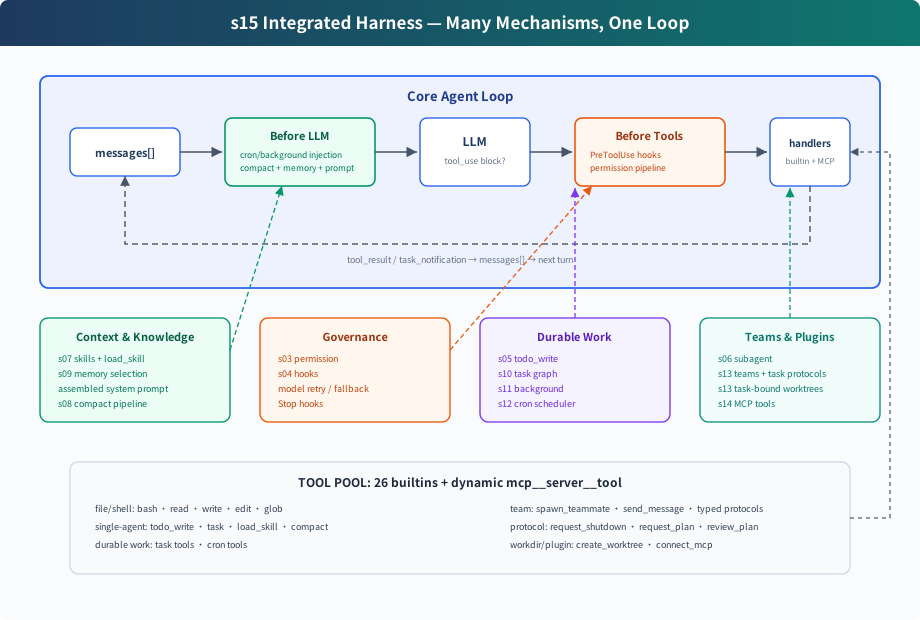
S15 does not introduce a new mechanism. It connects the components from the earlier chapters in one integrated harness:
user input
  → UserPromptSubmit hooks
  → cron/background notification injection
  → context compact
  → memory + skills + MCP state assemble the system prompt
  → LLM
  → has tool_use block?
      no  → Stop hooks → return
      yes → PreToolUse hooks + permission
          → TOOL_HANDLERS / MCP handlers / background dispatch
          → PostToolUse hooks
          → tool_result / task_notification back to messages
          → next round
The loop keeps the same structure: call the model, check whether the response contains a tool_use block, execute tools, and append results to messages. The presence of a tool_use block decides whether tool execution continues.
Where Each Component Sits
| Position | Component | Role |
|---|---|---|
| Around user input | UserPromptSubmit hooks | Log, inject, or audit user input |
| Before LLM | cron queue | Inject scheduled prompts into messages |
| Before LLM | background notifications | Inject completed background work as <task_notification> |
| Before LLM | compaction pipeline | Budget large outputs, trim history, compact old tool results, summarize when needed |
| Before LLM | memory / skills / MCP state | Assemble the system prompt so the model sees current capabilities and long-term context |
| LLM call | error recovery | Retry 429/529, escalate max_tokens, compact on prompt-too-long |
| Before tool execution | PreToolUse hooks + permission | Block dangerous commands, out-of-bounds writes, destructive MCP tools |
| Tool dispatch | assemble_tool_pool | Assemble built-in tools and dynamic MCP tools |
| During tool execution | background dispatch | Move explicitly marked bash work into a daemon thread and return a placeholder result |
| After tool execution | PostToolUse hooks | Large-output warnings, logs, post-processing |
| Back to loop | tool_result | One tool_result per tool_use, then the next model round |
| No tool_use this round / on stop | Stop hooks | Stats, cleanup, audit |
What code.py Contains
Tools and Dispatch
The built-in tool pool contains 26 tools:
bash, read_file, write_file, edit_file, glob
todo_write, task, load_skill, compact
create_task, update_task, list_tasks, get_task, claim_task, complete_task
schedule_cron, list_crons, cancel_cron
spawn_teammate, list_teammates, send_message
request_shutdown, request_plan, review_plan
create_worktree
connect_mcp
assemble_tool_pool() assembles these every round:
BUILTIN_TOOLS + connected MCP tools
BUILTIN_HANDLERS + mcp__server__tool handlers
After connect_mcp("docs"), the next round exposes tools like mcp__docs__search.
Permissions and Hooks
Permission is not hardcoded into the tool execution line. It is a PreToolUse hook:
blocked = trigger_hooks("PreToolUse", block)
if blocked:
    results.append(tool_result(block.id, blocked))
    continue
That means permission, logging, and audit logic all attach to the same hook point. Lead tools, one-shot subagent tools, and teammate tools all pass through PreToolUse; an allowed call then runs PostToolUse after its handler.
The policy does not trust an MCP server's own description as authorization. The host owns a small exact allowlist for known read-only calls; every other MCP tool asks the user. File tools are denied outside WORKDIR, and every bash command asks before execution. Only the foreground user turn may open an interactive approval prompt; asynchronous turns fail closed instead of competing with the main CLI for stdin.
Planning and Tasks
S15 keeps two planning layers:
todo_write: lightweight plan for the current session, kept in memory- task graph: cross-session, dependency-aware, claimable task files under
.tasks/task_*.json
The first keeps a single agent from drifting. The second supports team coordination.
They share an intent, not an implementation: todo_write replaces one session checklist, while task records have stable IDs and individual lifecycle updates. The separate task tool below means "dispatch one isolated subagent"; it is not the Task System.
Task graph construction remains two-phase in the integrated host: the Lead creates all task nodes first, then calls update_task with the runtime IDs returned by create_task. Teammates receive only list, claim, and complete operations, so dependency structure is fixed by the Lead before work is distributed.
Subagents and Teams
S15 has two kinds of delegation:
task: one-shot subagent. It uses an isolatedmessages[], discards intermediate context, and returns only a final summary.spawn_teammate: persistent teammate thread. When given a readytask_id, the runtime claims it before the thread starts; without one, the teammate can wait in IDLE for later work. A teammate without an assignment cannot use file or Shell tools. It followsWORK → result → IDLEwithout a fixed tool-round cap; model or dispatch failures emit anerror, and thread cleanup releases an unfinished assignment back to the task board. It drains its inbox before every model call, so direct messages and shutdown requests cannot wait behind an unbroken tool-use sequence. While idle it waits forMessageBusdelivery first, then scans ready tasks only after the wait times out and atomically claims at most one.
After spawning a teammate, Lead ends the current turn instead of repeatedly querying its status inside the model loop. A team event in Lead's mailbox makes the runtime start the next turn.
One-shot subagents solve context isolation. Persistent teammates solve long-running parallel collaboration.
Memory, Skills, and Prompt
S15 reuses the s09 memory runtime directly. Before each model call, it reads the .memory/MEMORY.md catalog, selects records relevant to the current request, and passes their contents to assemble_system_prompt(context). At the end of the turn, extract_memories() keeps information that can help in later sessions; when new records are stored, consolidate_memories() runs next.
The same system prompt also includes identity, tool guidance, the workspace, the skills catalog, and connected MCP servers. Skills contribute only their catalog; load_skill(name) loads full content on demand.
Compaction and Recovery
Before the LLM call, S15 runs the compaction pipeline:
tool_result_budget → snip_compact → micro_compact → compact_history
snip_compact archives the complete history before trimming its middle. micro_compact runs only above the context limit: it saves older consumed results before replacing them with recovery paths, keeps the latest 3 complete, and stops near 80% of the limit. If a new unseen result is itself too large, S15 keeps a preview and the full-output path before considering history summarization.
The model call is wrapped with recovery:
- 429: exponential backoff retry
- 529: exponential backoff, optionally switch to fallback model after repeated failures
max_tokens: raise max tokens, then request continuation- prompt too long: reactive compact and retry
Background and Cron
When a bash call sets run_in_background=true, the main loop returns a placeholder without waiting for the command:
should_run_background → start_background_task → placeholder tool_result
background done → task_notification → next round injects messages
Only explicitly marked bash calls enter the background path. A non-zero exit or worker exception produces a failed notification. Each shell runs in its own process group, which the runtime stops when the command or Agent process ends through the normal or SIGTERM path. A process that creates another session can leave that group.
The cron scheduler runs as a daemon thread and checks once per second. A durable one-shot job is persisted as pending_delivery before entering the queue and remains there until the model call containing its prompt succeeds; a failed call restores it to the queue, and a restart queues it again. Delivery is therefore at-least-once. The CLI watches cron_queue, Lead's inbox, and terminal background work; any of them can wake one automatic agent turn.
Worktree and MCP
The task-scoped worktree behavior inherited from s13 manages working directories:
- a pending, unowned task may remain in the main workspace or be bound by
create_worktree(name, task_id)to a separate branch and directory - creation prevalidates the task, name, path, branch, and Git registry; a failed Git command is reconciled against the registry and branch state, and any partial checkout remains unbound and preserved for manual recovery
- an idle teammate atomically claims one ready task; the assignment records both
task_idand its effectivecwd - Lead can also pass a ready
task_idtospawn_teammate; the thread starts only after the claim succeeds - all teammate file tools use that
cwd; only the owning teammate can complete the task, and the assignment stays selected until that model turn ends - removal stays in the host-side
remove_worktree()helper. The model cannot call it. The user or host first checks task ownership, assignment leases, background work, and Git state; destructive removal requires separate user confirmation
The worktree changes tool default directories. It separates working copies; it is not a sandbox, and process-group cleanup does not contain a process that starts another session. This is why deletion remains host-owned.
Claiming or releasing a Task changes the assignment version and invalidates an old plan approval. An ordinary send_message only delivers text; it changes neither the Task identity nor the plan state.
MCP owns external capability:
connect_mcp(name)connects a mock serverassemble_tool_pool()assembles MCP tools and rejects normalized name collisions- tool names use
mcp__server__tool
Changes from s14
| Scope | s14 MCP | s15 Integrated Harness |
|---|---|---|
| built-in tools | 6 | 25 |
| external tools | connected MCP tools | the same dynamic MCP path and host policy |
| local mechanisms | S04 tools, hooks, permission, MCP | todo, subagent, skills, compaction, memory, task graph, background bash, cron, teams, and worktrees |
| event sources | user input and tool results | user input, tool results, cron prompts, background notifications, and team events |
Try It
cd learn-claude-code
python s15_integrated_harness/code.py
Try:
Inspect this repository and tell me which Python files matter most.Search the connected documentation for agent loop guidance.Refactor the authentication module and login page in parallel in separate worktrees. Show me each plan before editing.Remind me about the meeting in 3 minutes.Install the dependencies in the background while you read README.md.
Watch for:
- whether each tool call passes through hooks/permission
- whether MCP tools appear on the next round after
connect_mcp - whether a bash call with
run_in_background=truereturns a background placeholder - whether cron automatically reminds you when the time arrives
- whether teammates submit plans and pause before approval
- whether an idle teammate atomically claims only one ready task
- whether every teammate file tool switches to the claimed task's
cwd - whether completion keeps the task
cwdthrough the rest of the turn and releases it at IDLE
Next
s16 Workflow Runtime adds a Workflow tool to this host. A workflow keeps a fixed orchestration path in code and records progress so the same run can resume.